viernes, 25 de enero de 2019

Maestría en ciencias de gestión ambiental

La imagen puede contener: texto
En este 2019 tu puedes lograr tus objetivos profesionales siendo parte del Instituto Politécnico Nacional, contando además con beca CONACYT. Te invitamos a cursar la Maestría en Ciencias en Gestión Ambiental en CIIDIR Durango. Checa la convocatoria en http://www.ciidirdurango.ipn.mx/OfertaEducativa/Documents/MCGA2019/MCGA%20CONVOCATORIA19.pdf 

Diplomado en Manejo y Conservación de Recursos Naturales

La imagen puede contener: 3 personas, texto

Curso de anillamiento

La imagen puede contener: texto

Técnicas de buceo aplicadas a la investigación

No hay descripción de la foto disponible.

Maestria en Desarrollo Rural Sostenible

No hay descripción de la foto disponible.

Doctorado elasmobranquios

Towards integrated adaptive management of an endangered elasmobranch in the North East Atlantic

Project Description
Increasing use is made of marine protected areas (MPAs) to locally manage and conserve marine biodiversity. Although highly mobile, with complex temporal and spatial movement patterns, many endangered elasmobranchs show site association to critical habitats at important life history stages. Consequently MPAs are considered a key management tool in shark conservation.

Low fecundity, long gestation periods and historical exploitation have precipitated severe declines in spurdog (Squalus acanthias) biomass in the North East Atlantic (NEA). As aggregating species spurdog are identified as both endangered in the NEA (IUCN) and paradoxically as choke species, fouling fishing gear. NEA populations are considered a single stock from tagging data, with wide-ranging regional movements characteristic. Yet recent work suggests some individuals display winter residency within the ’Loch Sunart to Sound of Jura’ MPA (Thorburn et al. 2015), originally designated to protect critically endangered flapper skates. Determining the status (source or sink) of current spurdog population(s) in this MPA, and connectivity via contemporary gene flow with other NEA populations, is paramount for viable population management. Identification and integration of residential behaviour may increase management effectiveness by identifying critical areas where MPAs could conserve migratory species.

Our previous genetic analyses revealed little population structure within the NEA, and identified relatives within aggregations (Thorburn et al. 2018), indicating unsuspected vulnerability through erosion of selectable familial variation, making estimates of effective population size, aggregation composition and provenance key questions in managing for viability. Indirect population genetic approaches function well where there is restricted gene flow and prior knowledge of population boundaries, yet these assumptions are difficult to justify for the highly mobile spurdog. Additionally, demographic interpretation of traditional analyses remains challenging, which integrate processes on evolutionary rather than contemporary timescales. However, information contained in the spatial distribution of close kin can provide direct estimates of population connectivity and have been successfully used for defining dispersal kernels, identifying the drivers of juvenile dispersal patterns, and investigating contemporary recruitment dynamics.

Approach: Juvenile and adult contemporary management relevant connectivity will be inferred from spatial distribution of parent-offspring, full- and half-siblings, identified from genome-wide SNP analysis, from the MPA and adjacent sites, and contrasted with indirect estimates of connectivity obtained from maternally inherited mitogenomes (Feutry et al. 2017). Additionally data on close kin pairs (parents and offspring) will be utilised in a close-kin mark-recapture (CKMR) approach to estimate absolute stock abundance. Provenance of individuals will be confirmed by lead isotope analysis utilising isotopic seascape approaches that we have developed and used for a variety of conservation issues.

This QUADRAT (DTP) project will provide training in core and generic skills, along with cutting edge technologies (population genomics, bioinformatics, stable isotopes and multi-elemental fingerprinting) integrating Biodiversity and Earth systems; translating into improved policy and practice for effective conservation management of endangered marine species.

Key questions: Does the existing MPA encompass recruitment areas? What temporal site associations exist? Is philopatry (return to natal sites) evident? Do adult abundance and productivity estimates suggest viable Scottish populations? What management measures are likely to sustain connectivity and viability?
Funding Notes
This studentship is available to UK and other EU nationals and provides funding for tuition fees and stipend, subject to eligibility.
Candidates should have (or expect to achieve) a minimum of a 2.1 Honours degree in a relevant subject.

APPLICATION PROCEDURE:

• Apply for Degree of Doctor of Philosophy in Biological Sciences
• State name of the lead supervisor as the Name of Proposed Supervisor
• State ‘QUADRAT DTP’ as Intended Source of Funding
• State the exact project title on the application form

Link

One Year Fellowship: Local Fishery Outreach Project Manager Mexico Full Time (100%)

The Blueyou group of companies is an international service and commercial business entity with a focus on sustainable fisheries
and aquaculture and their related value chains. The group offers consulting services, operates fisheries and aquaculture
improvement programs, manufactures and trades sustainable seafood products on a global level. Blueyou’s key focus is on
private sector solutions, business interventions and entrepreneurial approaches to seafood sustainability, the conservation of
the marine and aquatic environment as well as socially responsible and fair supply and value chains. For the specific purpose
of activating private sector capital to finance fisheries reform and ocean conservation, Blueyou has been establishing a
consortium program IMPACT BLUE with the US based company CATCH INVEST. IMPACT BLUE acts as service platform for
project development and investor engagement for financing fisheries transition.
For a new program by IMPACT BLUE in Mexico, we are seeking to fill a new position, starting March 2019.

https://drive.google.com/file/d/1Gs2JbQGZRvbvtGays_2SYo-Wy5fRlt79/view?fbclid=IwAR0VmxMdEcAaqXt874ZLsx6MJ5a4rlFwTP78kBGRfRECX2CnXdoB5J5r6tE

Abejas y árboles: ciclo de conferencias

La imagen puede contener: texto

Foro Azul

La imagen puede contener: 1 persona

La Universidad Nacional Autónoma de México#UNAM FES #Cuautitlán #Medicina #Veterinaria y#Zootecnia 
INVITAN al FOROAZUL 
Fecha: Del 5 al 8 de Febrero del 2019 de 9:30 a 13:00hrs
Lugar: Auditorio de MVZ, Campo Cuatro
Contenido Temático:
-Acuacultura
-Acuarismo
-Alimentación
-Bioseguridad
Organizadores: Comité de Generación MVZ 2015
Informes:
Comité de Generación MVZ 2015
comitemvz@outlook.com
- Martha Guadalupe Castillo Quevedo
maartquevedo.0611@gmail.com
- Erika Valeria Sanchez Ramirez
kikavaleria12@gmail.com

Becas Erasmus

La imagen puede contener: texto

Erasmus+ es el programa de la UE de apoyo a la educación, formación, juventud y deporte en Europa. Su presupuesto de 14.700 millones de euros ofrece oportunidades de estudio, adquisición de experiencia y voluntariado a más de 4 millones de europeos.

El programa Erasmus+, que se extiende hasta 2020, no se dirige solo a los estudiantes. En él se han fusionado siete programas anteriores y ofrece oportunidades a una amplia variedad de personas y organizaciones.
Para postularte debes presentar tu candidatura a las convocatorias anuales que ofrece la Unión Europea.
¿Qué ofrece la beca?
· Matrícula en el programa
· Estipendio mensual por €1,000 (2 años como máximo).
· Gastos de instalación por €1,000
· Contribución para gastos de viaje, visa e instalación.
· El tiquete internacional depende de la distancia desde el país de origen hasta el país anfitrión en Europa.
Fecha límite: Depende del Programa y la Universidad a la que te postules (entre febrero y marzo del próximo año).
Conoce más información de las BECAS para maestría ingresando en este enlacehttps://ec.europa.eu/programmes/erasmus-plus/opportunities/individuals/students/erasmus-mundus-joint-master-degrees_es

Pasantía Manu Learning Centre

La imagen puede contener: una o varias personas, texto y exterior

Reunion anual y convocatoria para ponencias Southwestern Association of Naturalists

La imagen puede contener: texto

“Programa de Investigación Verano 2019”

No hay descripción de la foto disponible.

CONVOCATORIA 2019

“Programa de Investigación Verano 2019”

http://www.anuies.mx/media/docs/avisos/pdf/190122142319UTD+Convocatoria+2019.pdf

Coordinador de Proyectos de Conservación

La imagen puede contener: océano y texto
¿Te gustaría vivir en La Ribera o Cabo Pulmo?
Revisa las bases de nuestra convocatoria en este enlace: https://bit.ly/2TOWPvp
Las solicitudes que no cumplan con las instrucciones anteriores o estén incompletas no serán consideradas.

Biólogo o ingeniero forestal

Biólogo o ingeniero forestal
Requisitos: Experiencia demostrable en levantamientos de vegetación, idealmente con experiencia con comunidades étnicas y etnobotánica.
Instituciones involucradas: Applied Biodiversity Foundation. (OIM) Organización internacional para las migraciones
Objetivo: Levantamiento de información biológica y etnobotánica en el marco del proyecto de identificación de las afectaciones culturales y ambientales en el territorio del pueblo indigena Wiwa en la Sierra Nevada de Santa Marta, en los municipios de San Juan del Cesar y Riohacha del departamento de la Guajira (Colombia).
Para aplicar a cualquiera de las convocatorias, los interesados deben enviar un correo electrónico al email: comunicaciones@appliedbiodiversity.org, con la palabra "Convocatoria" en el asunto; detallando la convocatoria en la que esta interesado y sus datos de contacto

Convocatoria para Biólogo de Campo en Isla Guadalupe

Biólogo de Campo
para el proyecto de restauración ecológica de Isla Guadalupe
Conservación de Islas es una organización de la sociedad civil que desde hace más de una década ha logrado la recuperación de numerosas poblaciones de plantas y vertebrados nativos insulares del noroeste de México. Actualmente la organización requiere de biólogos de campo para el proyecto de restauración ecológica de Isla Guadalupe, en particular el manejo de fauna invasora que ha causado la extirpación de especies de aves. Dicho proyecto es una parte muy importante del trabajo que realiza Conservación de Islas en el Noroeste del país. El puesto tiene énfasis en el manejo de mamíferos invasores.
Requisitos:
Maestría o Licenciatura en biología, Ciencias ambientales, Oceanología, Medicina veterinaria, Zoología, Ecología, Ingeniería forestal o carreras afines.
Experiencia amplia y demostrable en manejo de mamíferos terrestres y/o experiencia en monitoreo de vegetación.
Interés por la conservación y restauración ambiental.
Habilidad para la toma de datos en campo. Capacidad de análisis e interpretación de datos.
Deseable el conocimiento de idioma inglés y experiencia en organización de expediciones a campo.
Capacidad para elaborar reportes técnicos con excelente redacción.
Radicar en Ensenada.
Otros requisitos:
Disponibilidad inmediata. La sede de trabajo serán estancias prolongadas en campo (Isla Guadalupe).
Disponibilidad y habilidad para trabajo de campo por períodos prolongados (al menos 30 días) con comunicación limitada.
Habilidad para relacionarse con autoridades y habitantes de comunidades.
Excelente disposición y gusto para el trabajo en equipo.
Excelente salud y condición física.
Manejo del estrés, trabajar sin supervisión, proactividad, tolerancia a otras formas de pensar y a la convivencia cercana, y paciencia para realizar tareas repetitivas.
Experiencia probada con manejo de vehículos estándar en caminos de terracería.
Licencia de conducir.
Envío de documentos:
Curriculum Vitae con fotografía detallando las principales habilidades y experiencia comprobable de trabajo en actividades antes descritas.
Dos cartas de recomendación.
Credencial de elector escaneada por ambos lados.
Ensayo, de dos páginas como máximo, explicando aspectos relevantes de su vida profesional que indiquen que es la persona adecuada para esta posición.
Datos de contacto: Dirección, email, teléfono celular y dirección de skype.
Período de entrevistas: 24 y 25 de enero de 2019.
Cierre de la convocatoria: 25 de enero de 2019.
Sueldo: según aptitudes.
Favor de mandar documentación con un correo electrónico y anexos a:
ana.cardenas@islas.org.mx
Las solicitudes se recibirán hasta el 25 de enero de 2019 y se dará prioridad a aquellas que cuenten con todos los documentos solicitados.

Especialista en Monitoreo y Evaluacion

La imagen puede contener: planta, exterior y naturaleza
Buscamos Especialista en Monitoreo y Evaluación. El objetivo del proyecto es aumentar la efectividad de las #ÁreasNaturalesProtegidas en México para contribuir a la conservación de especies en riesgo. La convocatoria termina el próximo 30 de enero ➡️http://bit.ly/2FKvU09

10 Becas Master en Espacios Naturales Protegidos

La imagen puede contener: montaña, cielo, naturaleza, exterior y textoHASTA EL 15 DE FEBRERO DE 2019 se pueden solicitar online las becas que convoca de nuevo laFundación BBVA titulados y profesionales de América Latina interesados en cursar el MÁSTER EN ESPACIOS NATURALES PROTEGIDOS. Se convocan 10 becas para la edición del Máster que se celebrará en 2020. Toda la información en
https://www.biophilia-fbbva.es/becas/becas-master-espacios-naturales-protegidos-2020/


sábado, 5 de enero de 2019

Postdocs in Global Biodiversity Science and Conservation

Postdocs in Global Biodiversity Science and Conservation

Focal groups: mammals, butterflies, dragonflies, bees, epiphytes

Several positions are available associated with the Yale Center for Biodiversity and Global he positions offer broad thematic flexibility, and focal research questions may be macroecological, macroevolutionary, biogeographical, or conservation-focused. There is also openness regarding the preferred taxonomic study systems. Our current funding has a particular emphasis on mammals, butterflies, dragonflies, bees, and epiphytes, and we are especially (but not exclusively) interested in applicants who have experience in one of these groups. We ask candidates to briefly describe their preferred area of activity in the cover letter. Several junior or senior positions are available, with a typical contract length of 2-3 years.

The positions will be based at Yale University, with close collaborative links to our partners worldwide. The Yale BGC Center connects biodiversity scientists from across campus and hosts a range of speaker and workshop events. It supports research and training around the use of new technologies and data flows for model-based inference and prediction of biodiversity distributions and changes at large spatial and taxonomic scales. Flagship Center projects include Map of Life and associated activities supporting the Half-Earth Map and the development of the GEO BON Species Population Essential Biodiversity Variables. For animal movement data we are partnered with the Icarus initiative, a space station-based near-global GPS animal movement observation system, and Movebank, which supports the management and integration of movement data. For camera trapping data we are members of the Wildlife Insights initiative. Other Center initiatives include the integration of phylogenetic information with spatial distributions (e.g., VertLife), and the NASA-supported development and application of remote sensing-informed layers for biodiversity modelling (EarthEnv).

Yale University offers researchers and staff competitive salaries and a generous package of benefits. Yale has a thriving and growing community of young scholars in ecology, evolution and global change science in the EEB Department, the Yale Institute for Biospheric Studies, the Peabody Museum, and the Yale School of Forestry and Environmental Studies. The town is renowned for its classic Ivy League setting, 75 miles north of New York City. To apply please send, in one pdf, a short motivation (i.e. cover) letter, CV and names and contact information for three referees to michelle.duong@yale.edu, subject “BGC Postdoc” For questions contact walter.jetz@yale.edu. The final selection process will begin on 20 January 2018, but earlier applications are welcome and will be reviewed as received.

jueves, 20 de diciembre de 2018

Investigador Asociado C de Tiempo Completo en el área de Bio-matemáticas

 El Centro de Ciencias Matemáticas (CCM) de la UNAM Campus Morelia, invita a las personas que reúnan los requisitos a participar en el proceso de selección para ocupar el puesto equivalente a Investigador Asociado C de Tiempo Completo a contrato en el área de Bio-matemáticas con énfasis en investigación multidisciplinaria. Para mayor información consultar la liga: http://www.matmor.unam.mx/convocatoria-plaza-investigador-biomatematicas-2018 El registro de candidatos se cerrará el 31 de diciembre de 2018.

Estancia posdoctoral en CINVESTAV-Irapuato

Te invitamos a realizar una estancia posdoctoral con BECA en el Laboratorio de Evolución Molecular del CINVESTAV-Irapuato. Los temas de investigación están relacionados con la evolución de diferentes mecanismos moleculares como la recombinación meiótica y la regulación génica. Para más información del laboratorio favor de consultar nuestra página web: http://www.ira.cinvestav.mx/DrEugeniomancera.aspx. La fecha ideal de inicio es enero de 2019, pero puede ser flexible. Interesados favor de contactar por email a Eugenio Mancera (eugenio.mancera@cinvestav.mxanexando CV. Profesor Investigador, Departamento de Ingeniería Genética CINVESTAV-Irapuato Tel. (462) 623 9665.

Consultor(a) líder

El proyecto Conservación de Cuencas Costeras en el Contexto del Cambio Climático (C6)  busca: Un consultor(a) líder quien será un experto ambiental familiarizado con las actividades del proyecto y con los objetivos de desarrollo del proyecto (ODP). Será responsable del desarrollo del informe de la evaluación, que incluya la revisión de la implementación de los componentes y sub-componentes.
Fecha límite: 15 de enero.
Requisito: Posgrado (doctorado o maestría) en gestión ambiental o cualquier campo relacionado
Enlace.

Dos maestros en Ciencias Biologicas y Dos Biologos o carreras afines


Sonoran Institute México, A.C., busca a un Director de Oficina en Mexicali.

El Sonoran Institute México, A.C., busca a un Director de Oficina en Mexicali. El Director de Oficina será un gerente que supervisará las operaciones diarias de la oficina en Mexicali.

El candidato ideal tendrá un mínimo de 12 años de experiencia supervisando múltiples funciones de personal y gestión, así como una maestría u otro grado académico avanzado en políticas públicas en medio ambiente y recursos naturales, negocios o administración de empresas, y 7 años de experiencia trabajando en proyectos de conservación.

Consulta aqui.

Posicion posdoctoral en el British Antarctic Survey

Post Doctoral Researcher Vacancy at British Antarctic Survey
The British Antarctic Survey (BAS) are recruiting a Postdoctoral Researcher in Seabird Ecology to join the Ecosystems Team. The research carried out by this team is critical to the development of conservation and ecosystem-based management strategies and contributes to the development of UK government policy.
We are seeking an outstanding candidate with a PhD, relevant fieldwork experience, advanced knowledge of statistical analysis, excellent communication skills and a strong publication record.
The successful applicant will work on Project LOMVIA, whose aim is to describe the competitive interactions between high Arctic and temperate seabird species and how this varies with environmental conditions around the coast of Iceland. Project LOMVIA a component of the high-profile NERC Changing Arctic Ocean programme, which offers exciting opportunities for the post holder to network with leading international collaborators and develop their skills and reputation. Further information about Project LOMVIA can be found here.
The post holder will be responsible for collecting and analysing telemetry data and blood samples from Icelandic seabirds, writing papers for high-impact journals and presenting talks at international conferences. They will also be expected to contribute to the dissemination of findings to policy-makers and the general public.
Full details of skills specification and how to apply can be found here.

Doctorante con pinguinos en la Universidad de Tasmania

PhD studentship on crested penguins

Quantifying the ecological factors under-pinning population trends in crested penguins

The Institute for Marine and Antarctic Studies at the University of Tasmania has been awarded the BOU’s 2018 John and Pat Warham studentship for PhD studies into seabirds. IMAS, in conjunction with National Institute of Water and Atmospheric Research in New Zealand and the British Antarctic Survey in the UK, is seeking to recruit a PhD student from a Commonwealth country to study the foraging ecology of crested penguins, starting in mid 2019.
Project description.

The crested penguins (genus Eudyptes) are conspicuous and charismatic components of island ecosystems throughout the Southern Ocean. Regionally, the five species exhibit contrasting population trajectories, although none are thought to be increasing: rockhopper, erect-crested and Fiordland penguins are declining, whereas Snares and royal penguins appear stable. Indeed, excepting royal penguin, all are classified as ‘endangered’ or ‘vulnerable’ on the IUCN Red List. The ecological processes under-pining these trajectories are poorly understood, but issues such as changing resource base through completion, fisheries interactions or changing climates are likely to be key factors. Our capacity to address all of these issues is limited by our scant knowledge of habitat use and spatial dynamics, not least because penguins’ uses of marine systems and resources will likely respond to a changing marine environment, resulting from human activities, in ways that are currently difficult to predict. This PhD will address this significant data knowledge gap. The project will be underpinned by geolocation data, yielding year-round location, distribution and penguin track information. Data are available for Snares penguin (Snares Islands) and rockhopper penguin (Campbell Island), and there is logistic support in place to acquire the same data for erect-crested penguin at the Bounty and Antipodes islands, rockhopper penguin at Antipodes, Campbell and Macquarie islands over the course of the scholarship. Furthermore, we will also have access to similar data sets for a large proportion of crested penguin populations outside Australasia, providing a near-complete global marine distribution picture for the Eudyptes genus. These data would enable us to comprehensively examine the extent to which species exhibit spatial overlap or segregation, quantify differences in habitat preference and assess how varying distributions and habitat preferences affect exposure to threats and, therefore, contribute to differences in population trends. These data will be augmented with stable isotope dietary techniques.

This studentship is only available to Commonwealth citizens. The successful candidate should have:

• An MSc or equivalent (e.g. first class Honours in Australia)

• A good knowledge of R, especially spatial analysis

• Field experience working with wildlife

Please send applications (cover letter, CV and contact details of two referees) to Prof Mark Hindell, mark.hindell@utas.edu.au +61 3 6225 2645

Applications close 15 March 2019

domingo, 7 de octubre de 2018

El Fondo para el Sistema Arrecifal Mesoamericano lanza su 11a Convocatoria a proyectos.

Fondo SAM / MAR Fund
El Fondo para el Sistema Arrecifal Mesoamericano lanza su 11a Convocatoria a proyectos. En esta ocasión, como en la anterior, tres diferentes ‘cajas financieras’ son ofrecidas, con condiciones similares, pero cada una con sus propias especificaciones:
1. Programa de Pequeñas Donaciones :
Apoyo y Fortalecimiento de la Gestión de Áreas Marinas y Costeras Protegidas en el Arrecife Mesoamericano.
Esta es la usual modalidad de convocatoria del Programa de Pequeñas Donaciones. Su estructura y condiciones son las mismas como en convocatorias anteriores.
2. Iniciativa de Rescate de Arrecife:
Apoyo y fortalecimiento a la restauración, repoblación y rehabilitación de arrecifes de coral en la región del SAM.
Esta es la segunda convocatoria para la Iniciativa de Rescate de Arrecifes. Se enfoca en arrecifes de coral en la región, y no está restringida a áreas protegidas específicas. Otros aspectos varían de la convocatoria usual.
3. Belize Marine Fund:
Collaborating for Sustainable Marine Resources Management in Belize.
This is the third RfP for the Belize Marine Fund. It specifically addresses marine resources management and conservation in Belize. Other aspects also vary from the usual RfP.
Consulta las bases completas aquí.  Fecha límite: 15 de octubre 2018 antes de las 4:30 p.m. hora local de cada país.

Consultoría sobre la acuacultura en México

Consultoría sobre la acuacultura en México
Fondo Mexicano para la Conservación de la Naturaleza busca el servicio de una consultoría que realice un diagnóstico de la situación actual y la tendencia a futuro de la acuacultura en México, con el fin de comprender más sus impactos, desafíos, retos y las oportunidades para fortalecer a esta importante actividad económica para el país dentro de un marco de sostenibilidad ambiental, social y económica.
Consulta las bases aquí. Fecha límite: 11 de octubre 2018.

sábado, 6 de octubre de 2018

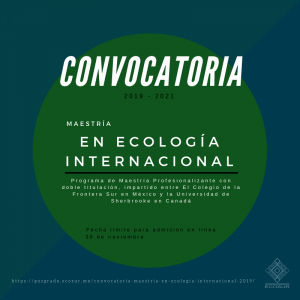
MAESTRÍA EN ECOLOGÍA INTERNACIONAL


http://serviciosposgrado.ecosur.mx/admisionESEI/convocatoria/Inicio.aspx

Ayudante para Investigador SNI nivel 3.

Invito los interesados a solicitar una plaza de Ayudante para Investigador SNI nivel 3. El Ayudante participará en actividades de biología molecular, sobre todo en secuenciación del ADN con un equipo de pirosecuenciación (metilación del ADN, SNPs, mosaicismo genético), bajo mi supervisión, en la Universidad de Guanajuato, Campus León. Más información sobre la investigación del laboratorio está en la página: silviozaina.com. El Reglamento de Ayudantes está disponible en la página CONACyT: https://www.conacyt.gob.mx/index.php/el-conacyt/sistema-nacional-de-investigadores/tramites-y-servicios/apoyo-para-ayudante-de-investigador-nivel-iii-o-emerito-del-sistema-nacional-de-investigadores Contactar a:  Silvio Zaina, szaina@ugto.mx